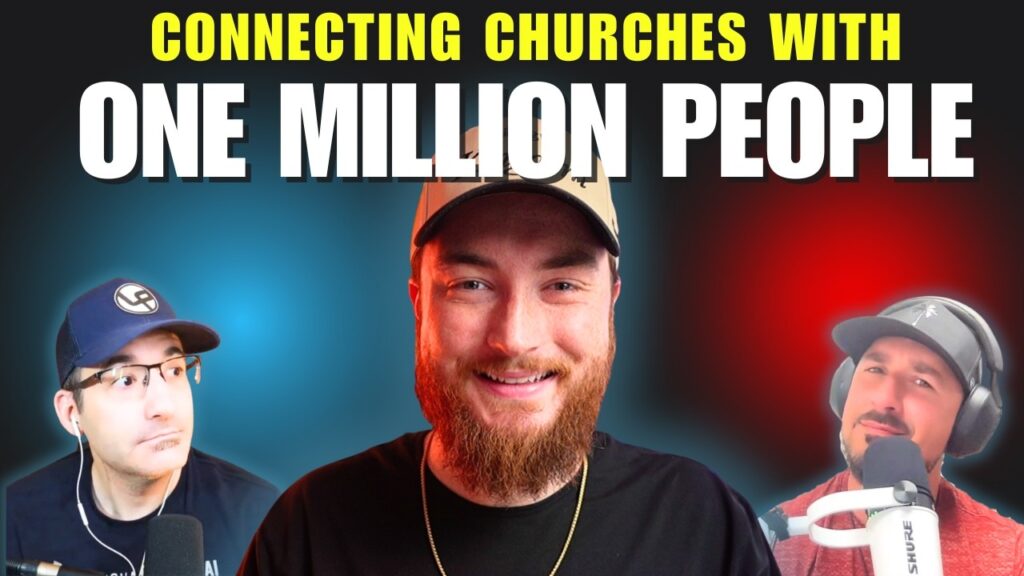
I had the chance to join Drew Barker and Tim Ferrara on the Eyes on Jesus Podcast to talk about something I care deeply about: how churches can use social media to reach new families and grow their congregations. This was a really fun conversation because Drew and Tim brought up some tough questions, including whether churches should even be on social media at all. I appreciated their honesty, and I think the conversation we had is one that a lot of pastors are wrestling with right now.
Is Social Media a Mission Field or a Minefield?
This was the big question that framed the whole episode. Drew and Tim had actually done a previous episode asking whether churches should delete social media entirely. So when I came on, they wanted to hear my perspective as someone who helps churches use these platforms every day.
Here is where I land on it: social media can absolutely be harmful. I do not deny that. But I also believe that if people are spending hours every day scrolling through their phones, the church has an incredible opportunity to meet them right where they are. We would never say “people go to coffee shops, so the church should avoid coffee shops.” Instead, we would say “let’s go be present there.” The same logic applies to digital spaces.
The churches that are thriving right now are the ones that have learned to use social media with purpose and intentionality. They are not just posting to post. They are creating content that speaks to real people with real needs, and they are inviting those people into community.
How Church Candy Got Started
Drew and Tim asked me about my background, and I shared the story of how Church Candy came to be. I went to Christ for the Nations Institute for my theology training, and then got my marketing degree from Dallas Baptist University. I spent time as a youth pastor and helped launch Vibrant Church in The Woodlands, Texas. That church still welcomes dozens of new guests every month thanks to the strategies we put in place early on.
After co-managing campaigns for over a thousand small businesses, I realized that churches were being underserved when it came to digital marketing. Most church marketing companies were charging too much and delivering too little. I knew there had to be a better way, and that is what led me to launch Church Candy in 2021. Within a year, it went from a side project to a full-scale operation, and today we work with over a thousand churches across the country.
The Power of Making People Feel Seen
One of the biggest points I made on the show is something I talk about constantly: the single most important thing you can do in digital outreach is make people feel seen. When someone clicks on your church’s ad or visits your website, they need to feel like you are talking directly to them. Personalized messaging, real follow-up, and intentional digital hospitality can help guests feel welcomed before they ever walk through your doors.
Too many churches treat social media like a megaphone. They blast out announcements and event flyers and wonder why nobody engages. The churches that are growing are the ones that treat social media like a conversation. They respond to comments, they send personal messages, and they make every new visitor feel like they matter. Because they do.
Why Different Church Sizes Need Different Strategies
Another topic we got into on the Eyes on Jesus Podcast was how marketing strategies need to look different depending on the size of your church. A church of 100 people should not be running the same playbook as a church of 2,000. The budget is different, the team is different, and the goals are different.
For smaller churches, I always recommend focusing on what you can do well with limited resources. That might mean running a simple Facebook ad campaign with a “Plan Your Visit” landing page, or having the pastor record a short welcome video each week. You do not need a massive budget to start seeing results. What you need is consistency and a clear call to action that makes it easy for someone to take the next step.
For larger churches, the strategy expands into things like multi-platform campaigns, retargeting, and more sophisticated follow-up systems. But the core principle stays the same: make it personal, make it easy, and make people feel welcome. If you want to see how some of these strategies have worked for real churches, check out the stories we have shared on this site.
How AI Is Changing Church Marketing
Drew and Tim also asked about the role of AI in church marketing, which is a topic that comes up more and more. My take is that AI is a tool, and like any tool, it can be used well or poorly. At Church Candy, we use AI to help churches stay consistent with their content without losing authenticity. It can help with things like writing social media captions, brainstorming sermon series promo ideas, or drafting follow-up emails.
The key is that AI should support your voice, not replace it. Your congregation does not want to hear from a robot. They want to hear from their pastor. Use AI to help you save time on the production side so you can spend more time doing what matters most: shepherding your people and being present in your community.
Are Churches Stealing from Each Other with Ads?
This was one of the more interesting questions that came up. Some pastors worry that running Facebook ads to attract new visitors is essentially “stealing” members from other churches. I understand the concern, but here is how I see it: the majority of people who respond to church ads are not regular churchgoers. They are people who have been thinking about visiting a church but have not taken that step yet. Your ad gives them the nudge they need.
And even if someone does come from another church, that is between them and God. Our job is to be faithful in putting the invitation out there. The goal of Church Candy has never been about competing with other churches. The goal has always been about getting new families into community, hearing the Gospel, and meeting Jesus.
Discipleship and Community Building Still Matter Most
Toward the end of the conversation, we talked about something that I think is the most important piece of all this: getting people in the door is only the beginning. If your church does not have a plan for discipleship and community building, all the ads in the world will not help you grow long-term.
Social media and digital ads are the front door. But what keeps people coming back is genuine community, strong teaching, and a place where they can grow in their faith. I always tell pastors that the best marketing strategy in the world cannot fix a broken guest experience. Get your follow-up right, get your Sunday experience right, and then use digital tools to bring more people through the door.
Final Encouragement for Pastors
I am genuinely grateful to Drew Barker and Tim Ferrara for having me on the Eyes on Jesus Podcast. Their heart for the church is obvious, and I love that they are not afraid to ask hard questions. If you are a pastor who has been unsure about whether social media is right for your church, I would encourage you to watch the full episode above and consider what it might look like to use these platforms with intention.
We are living in a time when more people can be reached with the message of Jesus than ever before. Social media is not going away. The question is whether the church will show up in these spaces with hope, truth, and love. I believe the answer should be yes. And if you need help figuring out where to start, my team at Church Candy would love to help you get there.
About The Author
